
While Petra justifiably dominates Jordan's tourism headlines, Jerash quietly offers one of the most complete and awe-inspiring Roman city experiences anywhere in the world. Unlike Rome itself — where ancient structures are interwoven with a modern metropolis — Jerash (ancient Gerasa) is a preserved Roman city you can walk through almost entirely intact. Colonnaded streets, soaring temples, functioning theatres, and vast public squares all stand remarkably complete after nearly two millennia. Yet remarkably, it receives only a fraction of Petra's visitors.
In This Guide
Jerash Through the Ages
Human settlement in the area stretches back to the Neolithic period, but Jerash truly flourished under Alexander the Great's successors, the Seleucids, who established a Hellenistic city here in the 3rd century BC. The city — then known as Antioch on the Chrysorhoas — grew steadily through the Hasmonean and early Roman periods.
The real golden age came after Rome incorporated the region in 63 BC. Under the Pax Romana, Jerash became one of the ten cities of the Decapolis league — a network of prosperous Greco-Roman cities stretching across present-day Jordan, Syria, and Israel. The construction boom that followed produced most of the monuments visible today. The population grew to an estimated 15,000–25,000 people, and the city's wealth derived from fertile agricultural land, trade routes, and its position as a regional administrative center.
Emperor Hadrian's visit in 129 AD prompted the construction of the grand triumphal arch that still greets visitors today — larger than many triumphal arches still standing in Rome. The city peaked in the 2nd and early 3rd centuries AD, with a forum, multiple temples, two theatres, public baths, and a colonnaded main street lined with shops. A series of Byzantine churches were added in the 4th–6th centuries, incorporating earlier Roman columns into their structures.
The Arab conquest of 636 AD brought a final phase of occupation, but a devastating earthquake in 749 AD caused catastrophic damage. The city was gradually abandoned, silted over by centuries of soil accumulation, and forgotten by the wider world until archaeologists began systematic excavations in the early 20th century. Today, excavations continue — Jerash is one of the most actively studied archaeological sites in the world, and new discoveries are made regularly.
The Main Highlights of Jerash
Hadrian's Arch
Your Jerash journey begins 500 meters before the main city gate at Hadrian's Arch (also called the Triumphal Arch). Built in 129 AD to commemorate Emperor Hadrian's visit, this three-bay arch stands 21 meters tall and was originally conceived as the new south gate of a city expansion that was never fully completed. Its scale is humbling — the central arch alone is wide enough to drive a large vehicle through — and the craftsmanship of its carved details remains crisp after nearly 1,900 years.
The Hippodrome
Between Hadrian's Arch and the old city walls lies the Hippodrome, the Roman chariot racing track. At 245 meters long, it could accommodate up to 15,000 spectators. It was one of the smallest hippodromes in the Roman world, but the track is well-preserved and gives a powerful sense of scale. Visitors can still see the starting gates (carceres) at the northern end. During the peak tourist season, the Hippodrome hosts theatrical Roman Army and Chariot Experience (RACE) shows — a theatrical re-enactment that is surprisingly engaging.
The Oval Plaza (Forum)
Passing through the South Gate into the city, you arrive at what is arguably Jerash's most unique monument: the Oval Plaza. Unlike the standard rectangular forums of most Roman cities, the Jerash forum is elliptical — 90 meters long and 80 meters wide — surrounded by a full colonnade of 56 Ionic columns. Archaeologists still debate why it was built in this unusual shape, with theories ranging from a desire to maintain an older sacred site to simple engineering adaptation to the natural topography. Whatever the reason, the result is extraordinary — a curving colonnaded space unlike any other surviving in the Roman world.
The Cardo Maximus
From the Oval Plaza, the Cardo Maximus (principal north-south colonnaded street) extends for over 600 meters through the heart of the city. Originally paved with large stone slabs — many of which survive — and flanked by hundreds of Corinthian columns, this was Jerash's main commercial artery. Look down and you can still see the deep ruts carved by centuries of cart wheels in the original paving stones. The columns along its length vary because many were re-erected after the 749 earthquake, but the overall effect of walking this ancient street between its forests of columns is profoundly moving.
The South and North Theatres
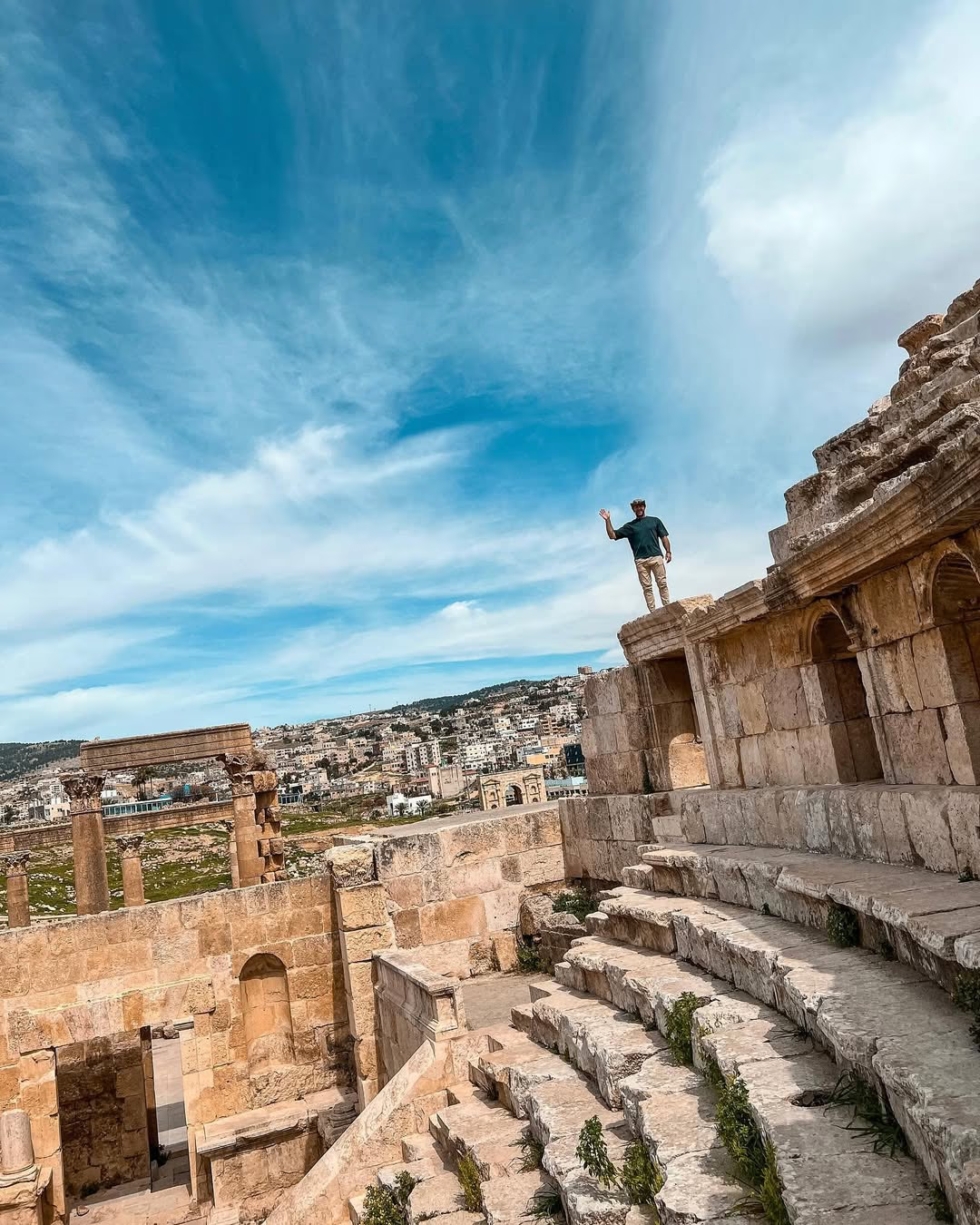
Jerash has not one but two remarkably well-preserved Roman theatres. The South Theatre, built in the late 1st century AD, held approximately 3,000 spectators across its 32 tiers of seating. The acoustics are exceptional — a single voice on stage can be heard clearly in the back row, demonstrating the extraordinary engineering understanding of Roman architects. The smaller North Theatre (originally a council chamber, or odeon) is even better preserved and offers a more intimate encounter with the Roman past.
The Temple of Artemis
Perched on a high podium above the western edge of the city, the Temple of Artemis was the grandest and most important religious monument in Jerash. Dedicated to the city's patron goddess, construction began around 150 AD. Of the original 12 towering Corinthian columns supporting its colonnade, 11 still stand — and an extraordinary detail is that on windy days, these columns can be seen to gently oscillate due to their perfectly engineered flexibility. Stand between them and look toward the mountains — the view and the scale of the structure leave most visitors silent.
The Nymphaeum
Halfway along the Cardo, the Nymphaeum served as the city's ornamental public fountain — the architectural showpiece of Jerash's water system. Its two-story facade features semi-circular apses, carved fish spouts, and marble cladding (some still visible). In its active days, water cascaded down its carved stone faces into a large basin, creating a cool, splashing centerpiece for the commercial heart of the city.
Lesser-Known Gems in Jerash
Most visitors follow the main trail between the South Gate and the Temple of Artemis. But Jerash rewards those who wander off the main route:
- The Cathedral and Fountain Court: A 4th-century Byzantine church built over an earlier temple, with a remarkable marble-floored atrium and a stairway fountain. The layers of construction — Roman, Byzantine, and early Islamic — visible in a single building tell the story of Jerash's entire history.
- The Church of St. Theodore: Adjacent to the Cathedral, this large 5th-century basilica retains beautiful mosaic floor fragments. Step down into the lower level to see the layers of occupation literally stacked on top of one another.
- The North Tetrapylon: The intersection of the Cardo and the north Decumanus is marked by four ornamental piers forming a square monument. It's rarely photographed but architecturally fascinating.
- The Western Baths: The ruins of a major Roman bath complex on the western edge of the city. Although unrestored, their sheer scale — the massive vaulted ceilings of the caldarium still partially standing — is awe-inspiring.
- The Upper Colonnaded Street (Decumanus): Follow the cross-city street west from the Cardo for quieter, less-visited monuments and city views that most visitors never see.
Practical Information for Visiting Jerash
- Location: Jerash is 48 kilometers north of Amman, a comfortable 45–60 minute drive. It's the ideal day trip from the capital.
- Time needed: Allow 3–4 hours for the main highlights. Half a day (with the RACE show) or a full day for the dedicated explorer who wants to see everything.
- Opening hours: The site is open daily. Hours vary seasonally — generally 8 AM until dusk. Arrive at opening time for the best light, fewest crowds, and cooler temperatures.
- Jordan Pass: The Jordan Pass includes Jerash entrance. If you purchase this for your Jordan trip, remember to print or download it before arrival.
- Footwear: The site involves significant walking on uneven ancient stone surfaces. Sturdy, comfortable shoes are essential.
- Sun and heat: Much of the site is fully exposed. Bring a hat, sunscreen, and at least 1.5 liters of water. There are several small cafes inside selling drinks and snacks.
- Photography: Early morning light on the golden limestone columns is exceptional. The South Theatre's interior is particularly photogenic in morning or late afternoon light.
- Guides: A licensed guide makes an enormous difference at Jerash. The site requires historical context to fully appreciate — the physical remains are spectacular but understanding what you're looking at transforms the experience.
What to Combine with Your Jerash Visit
Jerash pairs beautifully with other northern Jordan attractions for a full day out of Amman:
- Ajloun Castle (Qal'at Ar-Rabad): Only 24 kilometers west of Jerash, this 12th-century Islamic fortress built by a nephew of Saladin commands panoramic views across the forested hills of the Jordan Valley. A perfect pairing — ancient Roman civilization followed by medieval Arab military architecture.
- Umm Qais (ancient Gadara): Another Decapolis city in Jordan's far north, Umm Qais offers a very different Roman experience — a smaller, more intimate site perched on a cliff above the Sea of Galilee with staggering views across three countries. The black basalt architecture here is unlike anything else in Jordan.
- Dibeen Forest Reserve: Between Jerash and Amman, this protected forest of Aleppo and pine trees offers hiking trails and a rare taste of Jordan's green northern landscape, quite unlike the desert imagery most people associate with the country.
Explore Jerash & Northern Jordan with a Local Expert
Our guided day trips from Amman include Jerash, Ajloun Castle, and other northern highlights — with expert commentary that brings the ancient stones to life.
Book a Jerash Day Trip